MCFFS 2026:11: how your customers can meet the backup and recovery requirements
What MCFFS 2026:11 means
MCFFS 2026:11 is the Swedish Civil Defence Agency's (MCF) regulation and general guidance on security measures and management training for essential and important entities. It supplements the Cybersecurity Act (SFS 2025:1506), Sweden's implementation of NIS2, which has applied since 15 January 2026. The Act says organisations must take appropriate security measures. The regulation says which ones.
A large part of the regulation is aimed at management. Management must know enough to set cybersecurity objectives, judge which measures are needed and follow up on their implementation. It must also approve the security measures and be informed about the organisation's security level at least once a year.
The technical requirements are unusually specific. Multi-factor authentication is required for administrative access and for staff and suppliers connecting over external networks. Organisations must log unauthorised access attempts, use intrusion detection in the IT segments of the production environment, protect systems against malware and encrypt information. Security updates must be applied promptly, and software that no longer receives updates must be replaced. The general guidance says work on an update should begin within 72 hours.
On backup and continuity, the requirement is clearly worded: information must be recoverable within the downtime the organisation has defined as acceptable. Organisations must also decide the order in which systems are restored and practise alternative ways of working. The general guidance recommends keeping at least one backup on hardware separate from the source system and practising recovery of critical systems at least once a year.
MSPs that only provide managed ICT services to other businesses are covered solely by the management training requirement. Their own security requirements sit in EU Implementing Regulation 2024/2690 instead. However, the regulation also requires organisations to make sure suppliers meet the requirements wherever the organisation relies on them. If you handle backup, patching and security for a customer covered by the Act, expect questions about how you do it.
When production is covered too
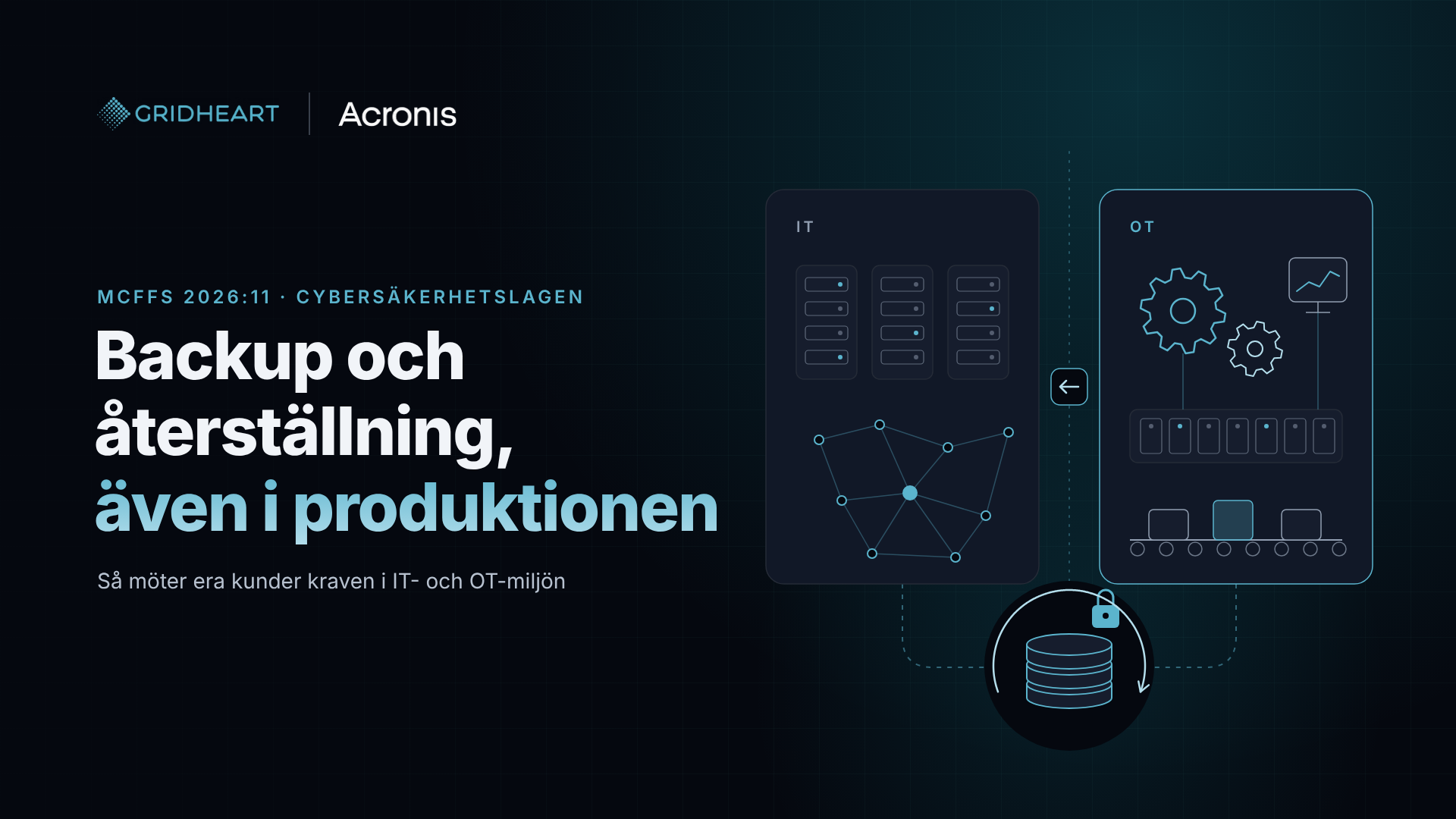
The regulation distinguishes between IT segments and OT segments, where an OT segment is the network that controls physical processes. The environment must be divided into segments that only allow approved data flows, and development and testing that could affect production OT must take place in separate environments. Multi-factor authentication is also required for administrative access to production OT segments, and organisations must have a process for security updates in OT.
In practice this is harder than it sounds. A control PC on a production line often runs Windows XP or Windows 7, is certified by the machine vendor in exactly that configuration and sits on a network with no internet connection. It cannot be patched every month and it cannot be taken offline for a long maintenance window. Acceptable downtime is measured in minutes, not days.
Where updates cannot be applied at the normal pace, the ability to restore a system quickly becomes the protection that actually holds. If a hard drive fails or malware gets in, the machine has to be running again before lost production gets expensive, and that has to be possible on site without someone from IT driving out.
How Acronis helps you meet the requirements
In the IT environment, Acronis Cyber Protect Cloud brings several of the regulation's technical requirements together in one agent and one console. Backup with immutable storage and copies kept outside the source system supports the requirement to recover within acceptable downtime. Active Protection and EDR cover malware protection, and vulnerability assessment and patch management provide evidence that updates are applied promptly. Backups can be encrypted with AES-256, and because everything runs on the same platform, the MSP can produce reports for the customer's management when it needs to be informed about the security level.
For the production environment there is Acronis Cyber Protect for OT. It supports legacy systems such as Windows XP, Windows Server 2003 and Windows 7, as well as Linux kernels from version 2.6.9. It can run fully disconnected from the internet with an on-site management server, and in hybrid mode all connections are initiated from the inside, so no inbound flows need to be opened towards the OT segment. That fits well with the regulation's requirements on segmentation and approved data flows.
When something goes wrong, the operator on site can restore the system with One-Click Recovery, without waiting for IT. Universal Restore lets a failed machine be moved to new hardware, and backups can be scanned for malware before they are restored. Backups can be taken without planned downtime, and by taking a backup before an update is installed there is always a way back if it disrupts operations. That makes it easier to build the OT update process the regulation requires, and to practise recovery for real.
No product makes an organisation compliant on its own. Risk analysis, continuity planning and management training remain with the customer. But backup, recovery, malware protection and patching are the areas where supervisors will ask for evidence, and there it is an advantage to be able to show all of it from a single tool.
Talk to us
Many MSPs already have customers covered by the Cybersecurity Act, and their questions will multiply when NCSC publishes more guidance around the turn of the year. As an Acronis distributor, Gridheart helps you package backup, recovery and protection for both IT and OT as a service your customers can point to when the supervisor gets in touch. Get in touch with us sales@gridheart.com and we will look at what that could look like for your customers.